
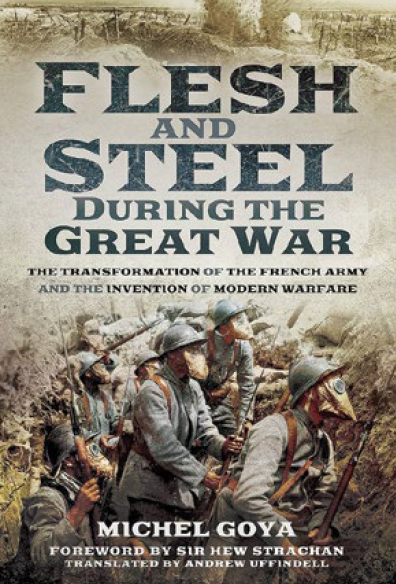
Dave Voisey, ‘Book Review: Flesh and Steel during the Great War: The Transformation of the French Army and the Invention of Modern Warfare’, Zero Post: The Journal of the Vickers MG Collection & Research Association, 2 (2026) <https://doi.org/10.61984/GPGG4729>.
Michel Goya (translated by Andrew Uffindell), (Pen & Sword, 2018).

The French army of the First World War is often maligned to an unfair extent in English texts. However, there has been a considerable academic renaissance regarding the French army in English language scholarship over the last twenty years. Anthony Clayton’s Paths of Glory (2005) and the late Elizabeth Greenhalgh’s entry in Cambridge University Press’ Armies of the Great War series, ‘The French army and the First World War’ (2014), have both greatly increased understanding of the French army.
Michel Goya’s ‘Flesh and Steel during the Great War’ is an essential addition to English language scholarship on the French Army in the First World War. Goya, a former Colonel in the Troupes de Marine, offers a unique perspective and is steeped in the culture of the French army. This perspective could be problematic, but Goya’s academic integrity and frankness when discussing the French army are refreshing.
Goya establishes the context of the French army at the beginning of the War with a huge emphasis on placing it within the context of the scars left by the Franco-Prussian War of 1870-1 and how the army of 1914 was an army still wrestling with the impact of that conflict. He pulls no punches in describing the issues faced by the French army in terms of training, doctrine and leadership. That being said, this does not set out to slander or maliciously target French high command, and with the context he establishes makes sense of the French operational art in 1914, flawed though it was.
The main premise of Goya’s work is how France came to reflect on the lessons of 1914 and how some of these lessons were arrived at faster than others. His central thesis is that the French army developed quickly from the lessons of 1914 and would eventually adopt an all-arms approach that prioritised the use of matériel in order to avoid a repetition of the casualties experienced in the first 18 months of the War. This concept, popularised now regarding the Western Allies of the Second World War, is given a strong case by Goya for the French pioneering this approach by the end of the First World War. He even goes as far as to have a chapter dedicated to how the ideal set-piece engagement would be conducted, something which is more often associated with the British Army.
The principal criticism of this work is its accessibility. This is not for the general reader and is quite clearly an adaptation of Goya’s doctoral thesis. At points, the book can feel rather impenetrable in terms of structure and does require an understanding of both the French army and the theories of military innovation. This is in no way questioning the translation, as having neither seen the original French text nor being proficient in the French language, it is not appropriate to question Andrew Uffindell’s translation. It would be fair to say that the nature of the topic is both complex and being written by a specialist, to whom the impact of the curse of the expert has meant that it would not necessarily be the first choice of those new to studies of the French army.
Even with the criticism above taken into account, this book is essential reading for anyone who wishes to truly understand the development of the French army or how militaries learn. With some contextual grounding, this book will provide countless, well-evidenced and conveyed pictures of how the French army adapted. It is a book that has been used within secondary and A-Level teaching for this very reason.
Review by Dave Voisey


